Continuous Measurement Methods for Transient Physiological Discomfort in VR Locomotion
ACM CHI 2026
Abstract
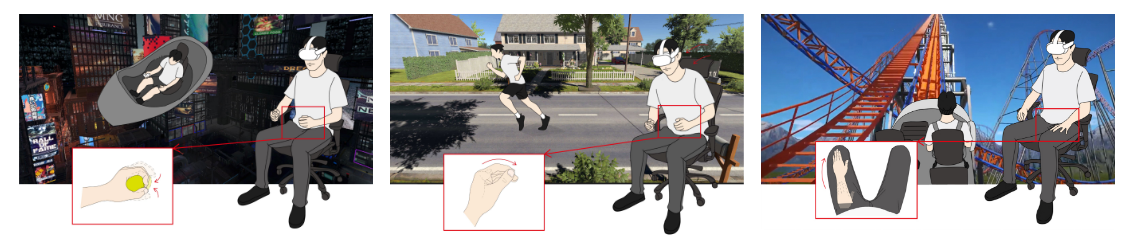
Motion sickness, in addition to its persistent long-term effects, also exhibits short-term effects characterized as transient physiological discomfort, which changes rapidly with variations in locomotion. However, such discomforts are challenging to assess using current subjective scales and objective physiological measurements. To tackle this issue, this paper suggests continuous measurement methods designed specifically for evaluating transient physiological discomfort during VR locomotion. Through a user-elicitation study, three preferred measurement methods—'squeezing ball', 'sliding thumb', and 'rubbing thigh'—were identified. These techniques were then evaluated for reliability, validity, attention, presence, and workload, with 'sliding thumb' identified as the most effective option. The paper expands traditional measurement methods to capture users' physiological experiences in VR interactions, offering practical choices for researchers in this field along with an in-depth discussion of design considerations, detailed implementation guidelines, and potential ways to optimize the VR experiences utilizing the measurement data.